
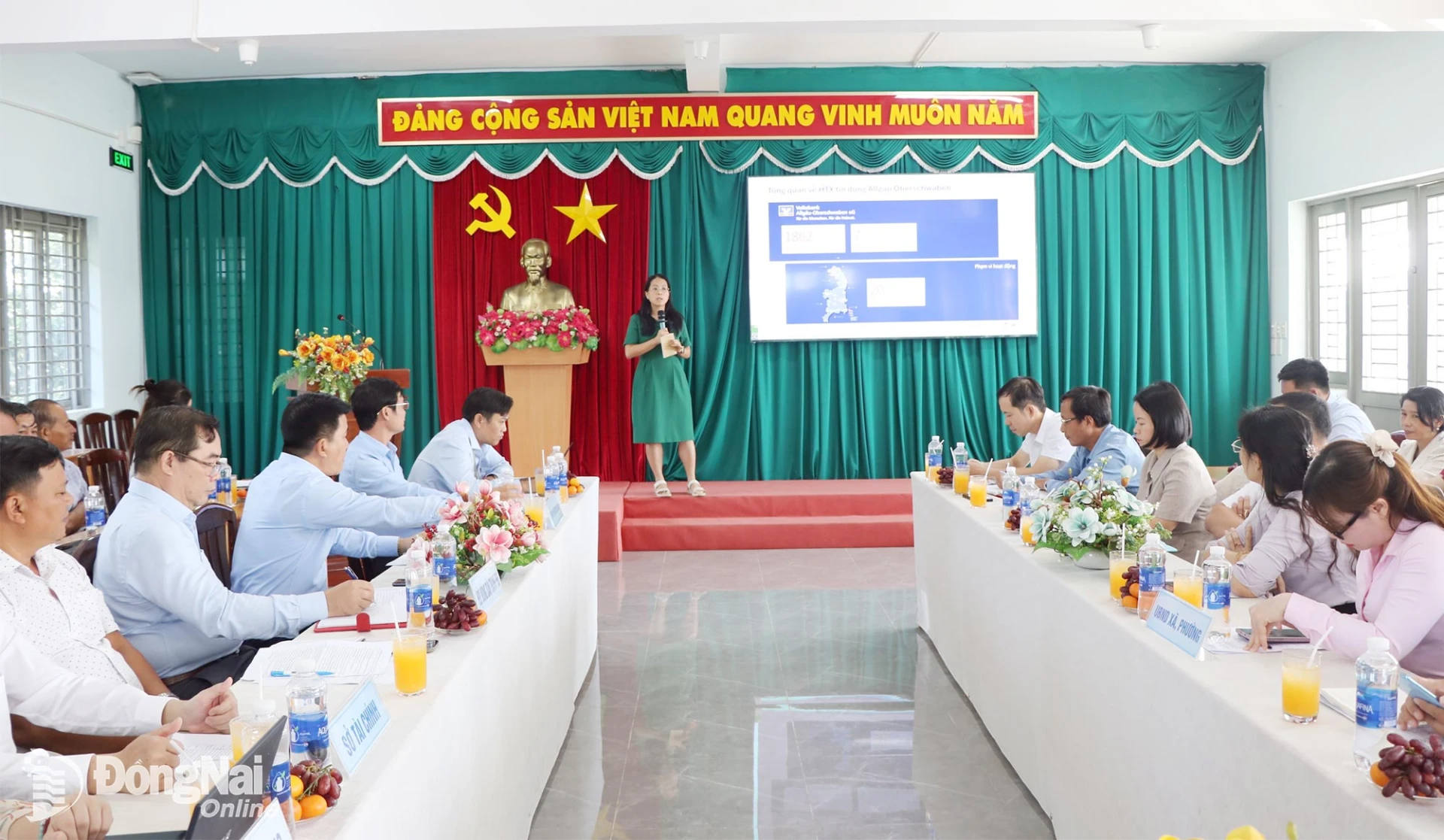
On the morning of November 7, Nguyen Thi Cat Tien, Member of the Dong Nai City Party Committee, Vice Chairwoman of the City People’s Committee, chaired a meeting of the appraisal council to consider recognizing communes that meet the new-style rural development standards in 2026. Six communes were assessed, namely Phu Vinh, Dinh Quan, Thong Nhat, Xuan Bac, Xuan Dinh and Cam My.
 |
| Nguyen Thi Cat Tien, Member of the Dong Nai City Party Committee, Vice Chairwoman of the City People’s Committee, chairs a meeting of the appraisal council to consider recognizing communes that meet the new-style rural development standards in 2026. Photo: B. Nguyen |
All six communes have met the criteria for integrated rural infrastructure development. At least 57% of commune roads are lined with trees, with some localities reaching 100%. Telecommunications infrastructure provides mobile coverage and internet access to 100% of rural residential areas and production zones. Irrigation facilities managed by the communes are maintained annually, ensuring that at least 91% of agricultural land receives adequate irrigation and drainage services. The rates are particularly high in Thong Nhat Commune, at over 99%, and Phu Vinh Commune, at more than 98%.
 |
| Leader of Phu Vinh Commune speaks at the appraisal meeting. Photo: B. Nguyen |
The localities have given priority to developing production and raising incomes. They have established numerous high-tech agricultural production models and developed products under the One Commune, One Product (OCOP) program. Many concentrated raw material production areas for the communes’ key crops and livestock have obtained quality certifications, with production linked to processing and market distribution. Notably, average per capita income in all six communes increased by more than 10% in 2026. In some communes, it exceeded VND98.5 million per person, with Xuan Dinh recording nearly VND103.6 million per person.
 |
| Leader of Xuan Dinh Commune presents her report at the appraisal meeting. Photo: B. Nguyen |
All six communes have adequate cultural facilities in accordance with regulations, and 100% of their schools meet national standards. Commune health stations and satellite medical facilities are generally equipped with sufficient infrastructure and medical equipment to maintain operations and provide healthcare and public health protection services to local residents. Poverty reduction and social welfare have also received due attention, with the multidimensional poverty rate remaining below 1.1%.
Digital transformation in agriculture and environment sector has been effectively implemented across the communes. Each locality has at least one hamlet meeting all technical standards and operational requirements for the smart hamlet model. Rural environmental protection and landscape improvement have also been prioritized, resulting in numerous bright, green, clean and beautiful roads and model residential areas. The six communes have met all four requirements for security and public order. In particular, Phu Vinh Commune was assessed by the City Public Security as having no outstanding shortcomings or limitations in its locality.
 |
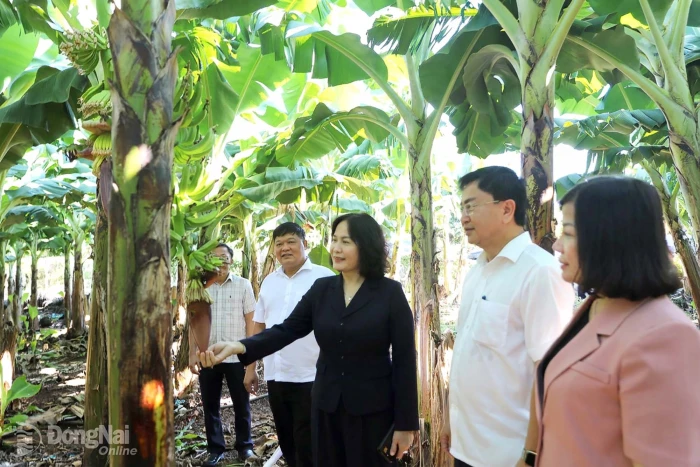
| Nguyen Thi Cat Tien, Member of the Dong Nai City Party Committee, Vice Chairwoman of the City People’s Committee, inspects a model new-style rural road in Dinh Quan Commune. Photo: B. Nguyen |
Following the council's vote, all six communes were recognized as meeting the new-style rural development standards for 2026. Surveys of residents’ satisfaction with the rural development program also recorded high approval rates.
Vice Chairwoman of the Dong Nai City People’s Committee Nguyen Thi Cat Tien emphasized that the six communes represented the first models to achieve the standards under the two-tier local government model and should serve as pilot examples for wider replication in the coming years. Although the appraisal council had approved their recognition, some newly introduced criteria had only been met at a basic level. The communes must therefore continue improving and upgrading their performance in these areas, she said.
Although Dong Nai is an industrial city, 80% of its population lives in rural areas. Communes must therefore continue prioritizing crop and livestock development to generate income for residents. Agriculture remains an important driver of economic growth, and local authorities need to focus on solutions that promote agricultural growth and build value chains. In 2027, Dong Nai aims to have an additional 23 communes meet the new-style rural development standards. Therefore, the communes must begin preparations in 2026 and make every effort to fulfill their assigned tasks, she stressed.
By Binh Nguyen - Translated by Mai Nga, Thu Ha
Thông tin bạn đọc
Đóng Lưu thông tin